[ad_1]
The German winegrowing According to the farmers’ association, is in great difficulty. “While the 2025 harvest is considered to be exceptionally good in terms of quality, the industry is in a historic economic crisis,” the dpa news agency quoted from a market report by the German Farmers’ Association.
The economic situation is “dramatic”it says. Barrel wine prices of 40 to 60 cents per liter would have been far below the production costs of around 1.20 euros.
Association president Joachim Rukwied was quoted as saying that viticulture is in the biggest crisis in decades: “Due to the poor market situation, we assume that we will lose a significant amount of vineyard area.”
According to the farmers’ association, the domestic market share of German wine has fallen to 41 percent. In addition, exports have been affected by tariffs USA as the most important sales market for German wine.
Lowest harvest in 15 years
In the current year, the wine harvest was 7.3 million hectoliters, 16 percent below the ten-year average. This was the lowest harvest volume since 2010. The large growing regions of Rheinhessen, Palatinate, Baden and Württemberg were particularly affected, some of which had volume losses of 20 percent compared to the previous year. “In contrast, regions such as the Moselle, Saxony and Saale-Unstrut recorded significant increases after the frost year of 2024.”
All 13 German growing regions reported “exceptionally high grape quality,” the farmers’ association said. “The wines of the 2025 vintage are considered aromatic, concentrated and elegant. Small berries and intensive selection resulted in high quality but reduced quantities.” Almost two thirds (64 percent) of wine is sold through supermarkets.
“Drink more German wine”
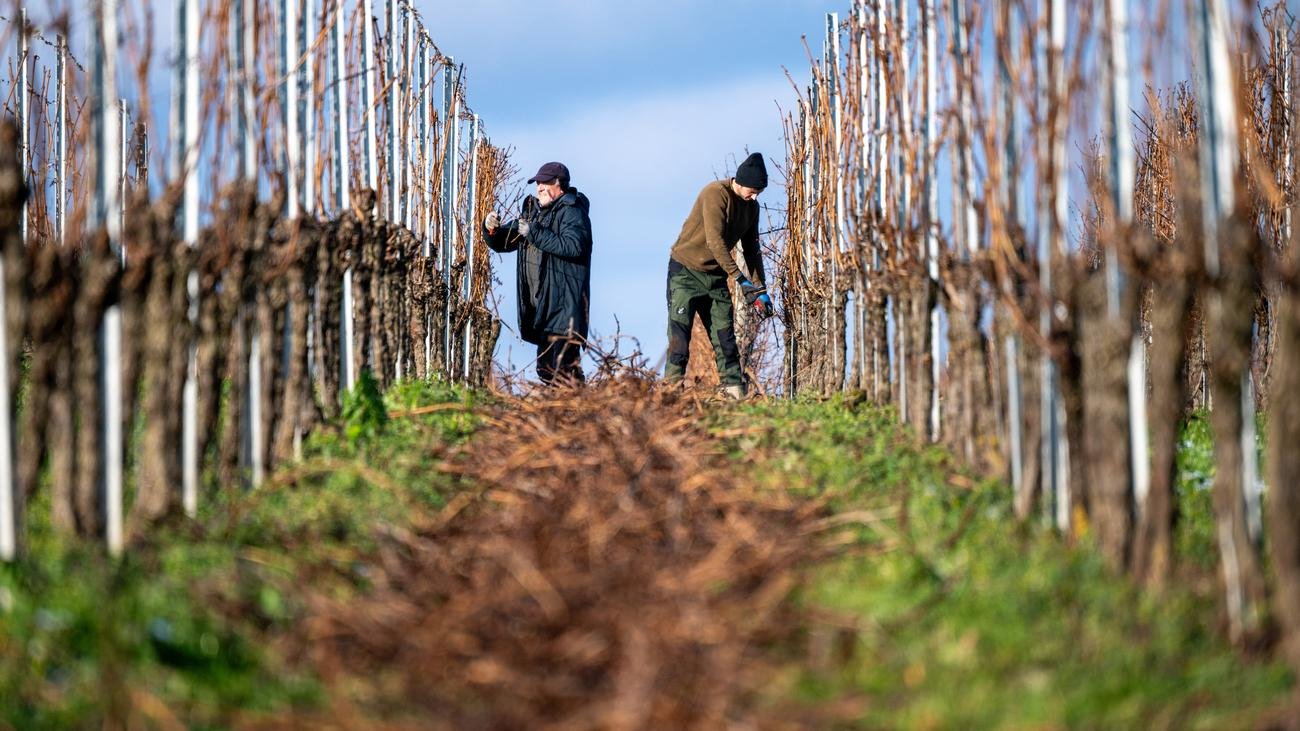
According to the farmers’ association, there are also structural problems. “Seasonal workers are becoming increasingly difficult to find, and in many companies the wage costs exceed the achievable revenue,” said the association. The rising minimum wage is an “additional massive burden”. Winegrowers with areas on steep slopes are particularly affected, as cultivation there can hardly be mechanized.
Given the situation on the German wine market, the farmers’ president is calling on consumers to drink more local wine. “I appeal to consumers: drink more German wine,” he told the Rhenish Post. “We offer qualities that easily match wines from France, Spain or Italy can keep up.”
[ad_2]